Why 100m of Sandbag Lunges Separates Prepared from Unprepared
Of all eight HYROX stations, the sandbag lunge is the one that most reliably exposes gaps in preparation. Not because it's the hardest.
Because of when it appears.
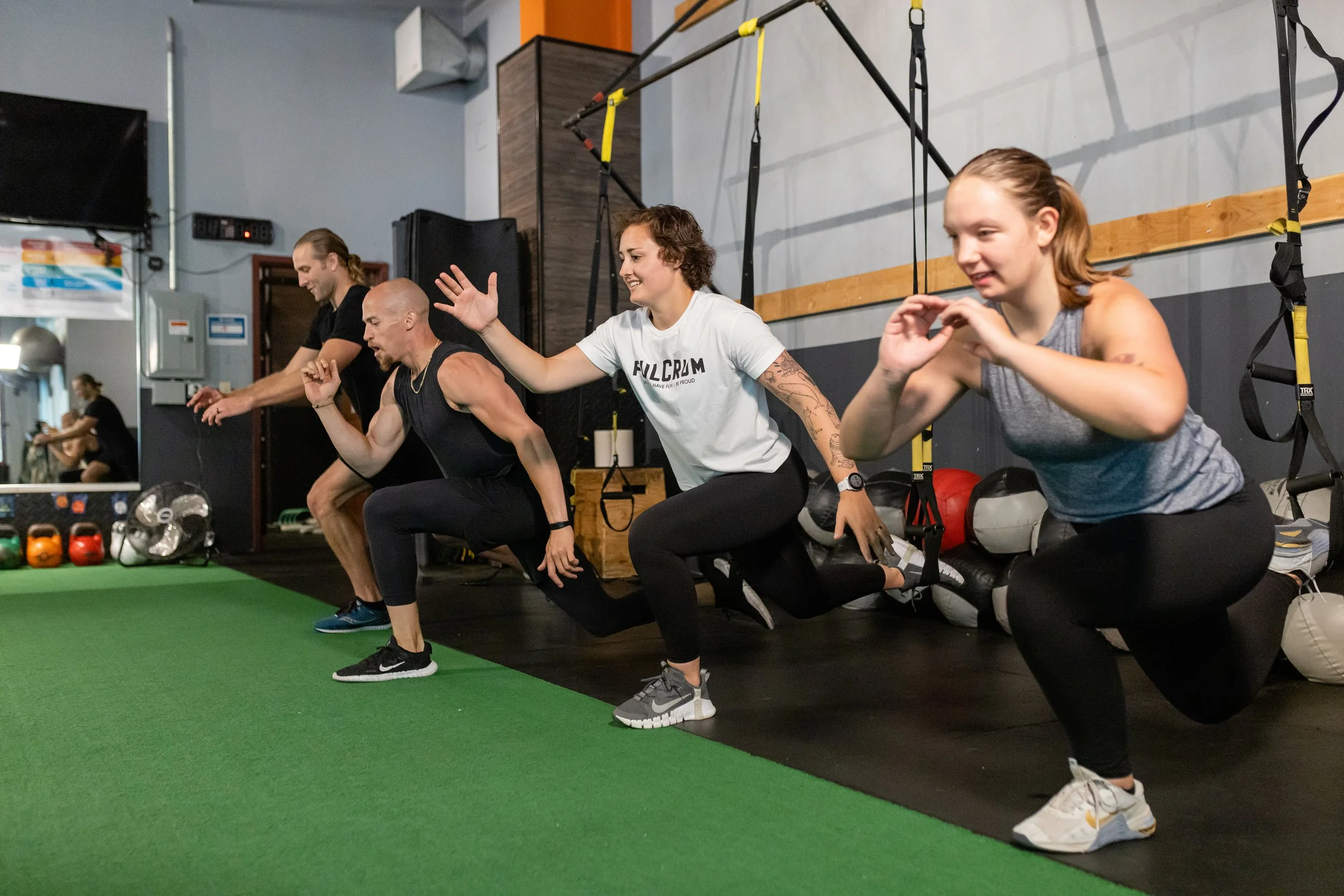
Station seven. You've run seven kilometers. You've pushed and pulled a sled, rowed 1,000 meters, done 80 burpee broad jumps, carried heavy
implements for 200 meters. Your legs have been working for over an hour. Your lungs are running hot. Your grip is spent.
Now pick up a sandbag, put it on your shoulder, and lunge 100 meters.
Why this station is different
The sandbag lunge makes demands that most compound training doesn't address directly. It's not a bilateral movement — both legs aren't working
simultaneously. It's not a static single-leg position. It's a continuous, alternating, single-leg loading pattern under an unstable anterior
load, sustained for distance, under cardiovascular and muscular fatigue.
Break that down: single-leg force production, hip stability at the stance leg, knee tracking under load, anterior core bracing against a load
that wants to pull you forward, and the ability to generate force on one leg while the other one recovers before it becomes the stance leg
again.
Most gym training addresses bilateral strength well. Squats, deadlifts, leg press — both legs together. These build a foundation. But they
don't specifically develop the hip stability and single-leg coordination the sandbag lunge demands, and the gap shows up clearly in a race.
The hip stability problem
Every time you lunge, your stance leg is doing three things simultaneously: absorbing the load of your bodyweight plus the sandbag,
maintaining a stable hip position so your pelvis doesn't drop, and producing enough force to drive your body forward into the next step.
Hip stability — the ability to keep your pelvis level during single-leg loading — is governed primarily by the hip abductors: the gluteus
medius, gluteus minimus, and tensor fasciae latae. These muscles are often underdeveloped in athletes whose training is primarily bilateral,
because bilateral movements don't require them to work in isolation.
When the hip drops during a lunge — when you see that characteristic lateral shift of the torso — it's not a flexibility problem. It's a hip
abductor strength and coordination problem. And it becomes much more pronounced under fatigue, when your nervous system is rationing effort
and the stabilizers are among the first things to go quiet.
The sandbag specifically
A barbell or dumbbell sits in a fixed position. A sandbag shifts. The load moves as you move, creating unpredictable perturbation that demands
constant adjustment from your core. This is called an unstable load, and it adds an anterior bracing demand — your core must resist being
pulled forward by the bag — that a barbell lunge doesn't fully replicate.
Training with sandbags, slosh pipes, or any implement that moves during the lift develops this quality directly. But even without them,
understanding the anterior bracing demand helps you train for it: any lunge variation where you're resisting forward lean, maintaining a tall
torso against gravity, is building the same quality.
What we train
Reverse lunges are the foundation. They develop single-leg strength and hip stability in a movement pattern that closely mimics the sandbag
lunge without the forward momentum that makes standard lunges harder to control under fatigue.
Step-ups develop hip stability at the stance leg under load, and they allow us to increase load progressively while keeping the movement
pattern clean. They're also one of the best tools for developing the specific glute activation that keeps the pelvis stable during single-leg
work.
Bulgarian split squats are the heavy single-leg strength builder — rear foot elevated, full range of motion, loaded progressively. They
develop the quad and glute strength to drive force production through one leg, and the hip stability to do it without compensating.
Contralateral loading — holding a weight on the opposite side from the working leg, or pressing overhead during a lunge — adds an
anti-rotation and anti-lateral flexion demand that trains the core in the positions the sandbag lunge will put it in.
All of this is trained under fatigue. A Bulgarian split squat done fresh is useful. A Bulgarian split squat done after 20 minutes of
cardiovascular work is HYROX-specific preparation.
The 100 meters
One hundred meters of lunges is a long way. At pace, it's somewhere between 65 and 80 repetitions — alternating legs, each one a single-leg
loading event. For athletes who've trained for it, this station is hard but manageable: a grind they've rehearsed, with a clear end point.
For athletes who haven't, it tends to be where races unravel. The lunges slow dramatically. Posture deteriorates. The knee tracks inward. The
torso tilts. What should take 3–4 minutes takes 6–7, and the legs that have to run one more kilometer and do wall balls afterward are
significantly more compromised.
The difference is almost entirely preparation. The fitness to complete 100 meters of lunges late in a race is not rare — most HYROX athletes
have it. The specific single-leg strength and hip stability to do it efficiently, with good mechanics, is less common. That's the gap worth
closing.
---
Part of the Fulcrum HYROX Training Series — full station breakdown here.
Training for HYROX in Portland? Book a free consult.