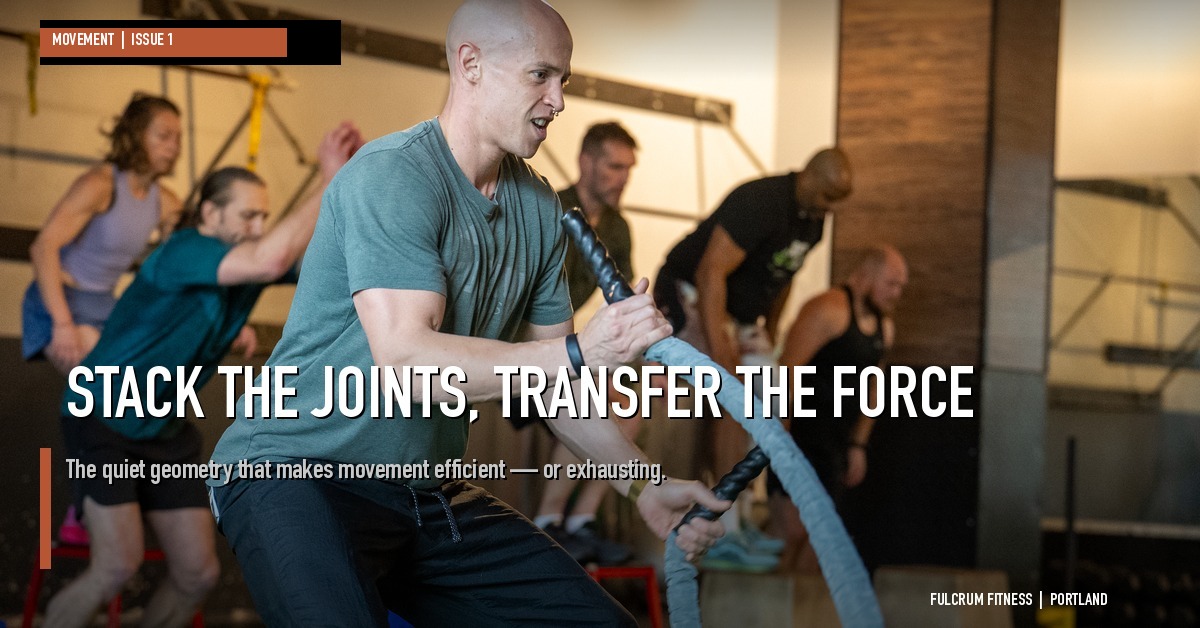
Stack the Joints, Transfer the Force
Movement Pillar · Issue 1 | 5 min read
Every time you move, your body is solving a physics problem. Force generated by your muscles has to travel somewhere — through bones, across joints, into the ground or into a load. When your joints are well-aligned, that force moves along the path of least resistance, reaching its destination cleanly. When they’re not, the force leaks.
Other structures — tendons, smaller stabilizing muscles, connective tissue — absorb what the primary system couldn’t handle. That’s not inherently dangerous in small doses, but over time it’s the difference between training that builds you up and training that quietly wears you down.
What Joint Stacking Actually Means
Joint stacking is the principle that load transfers most efficiently when joints are vertically aligned over one another relative to the direction of force. Think of a squat: when your knee tracks over your foot and your hip sits over your knee at the bottom, the compressive force from the barbell travels in a relatively straight line through your skeleton to the floor.
Shift that knee inward or let your torso collapse forward, and suddenly you’ve introduced torque — a rotational force the joint wasn’t designed to manage at high load. The muscles around the hip and knee now have to work overtime just to stabilize what poor geometry created, leaving less capacity for the actual work you came to do.
It’s Not Just About Lifting
This isn’t just a weightlifting concept. It shows up in running gait, in how you carry groceries, in the way you sit at a desk for eight hours before a workout.
The body is remarkably adaptive — it will find a way to complete a movement pattern even when the mechanics aren’t ideal. But adaptation has a cost. Compensations layer on top of compensations, and what started as a slightly rotated hip or a habitually forward head becomes the blueprint your nervous system defaults to under fatigue or load. Understanding joint stacking isn’t about achieving some perfect textbook position — it’s about giving your body the structural advantage it deserves.
Why Awareness Is the First Step
The encouraging part is that awareness moves quickly. Most people, once they feel what a well-stacked position actually feels like — the subtle sense of support from the ground up, the way effort distributes across a movement instead of concentrating in one spot — start to recognize it everywhere.
It becomes a kind of internal feedback loop. You’re not chasing perfect form as an aesthetic; you’re reading your own force transfer in real time. That’s a skill, and like any skill, it sharpens with practice and good coaching.
Try This Week
Pick one movement you do regularly — a squat, a hinge, a push-up, even just standing up from a chair — and pause at the bottom or mid-point to do a quiet joint check. Are your ankles, knees, and hips stacked in the direction you’re pushing or pulling? Is your spine long, or collapsed? You don’t need to fix anything dramatically. Just notice. That noticing is where better movement begins.
This is Issue 1 of the Fulcrum newsletter — a series covering the four pillars of intelligent training: Movement, Mindset, Nourishment, and Recovery. Learn how we train at Fulcrum →